
Every time we make a UPI payment, ask an AI chatbot a question, upload a photo to the cloud, or stream a movie online, we interact with a world that feels entirely digital. Yet behind these everyday activities lies a massive physical infrastructure of servers, cables, power systems, and data centres working around the clock. The modern digital economy may appear invisible, but the systems that keep it running are anything but.
India is currently witnessing an unprecedented digital transformation. The rise of artificial intelligence (AI), cloud computing, digital banking, e-governance, and online commerce has created an enormous demand for data storage and processing. At the same time, concerns about privacy, cybersecurity, and national security have strengthened the argument that Indian data should remain within India's borders. This idea, widely known as data sovereignty, has become a key pillar of the country's digital strategy.
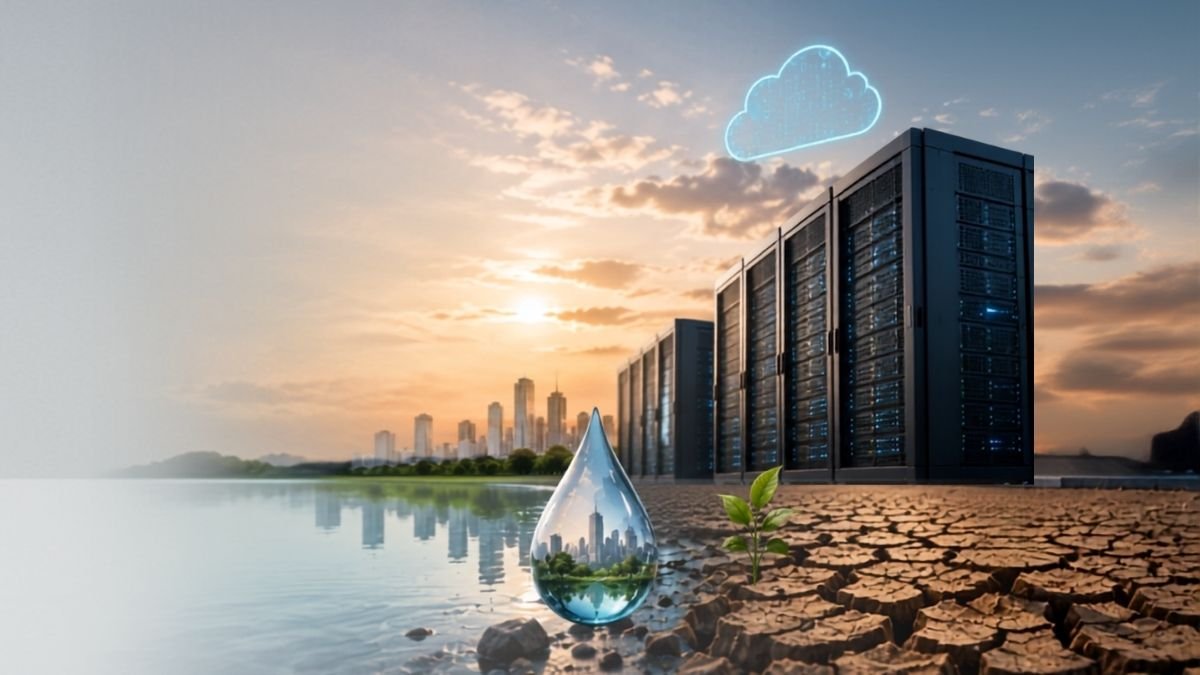
However, there is a side to this story that often escapes public attention. Data centres—the buildings that store and process digital information—consume large amounts of electricity and water. While energy consumption is widely discussed, the issue of water usage remains relatively hidden. Cooling thousands of high-performance servers requires significant quantities of water, and many of India's data centres are being built in urban regions that already struggle with water scarcity.
This creates an important question for policymakers, businesses, and citizens alike: Can India achieve digital sovereignty without placing additional pressure on its already stressed water resources? The answer to this question could define the future of the country's digital infrastructure and its environmental sustainability.
In the twenty-first century, data has become one of the world's most valuable resources. Governments increasingly view data not only as an economic asset but also as a matter of national security and strategic importance. Personal information, financial records, healthcare databases, and digital communications all form part of a nation's digital ecosystem.
Data sovereignty is the principle that data generated within a country should be governed by that country's laws and, in many cases, stored and processed within its borders. The concept has gained prominence globally as countries seek greater control over their citizens' information and reduce dependence on foreign digital infrastructure.
For India, the push toward data sovereignty is driven by several factors. First, local data storage strengthens privacy and regulatory oversight by ensuring that domestic laws apply to sensitive information. Second, it enhances cybersecurity by reducing reliance on overseas servers and infrastructure. Third, it supports India's vision of becoming a global digital and AI leader by encouraging investments in domestic cloud and data centre capacity.
India's digital economy is expanding at a remarkable pace. Millions of online transactions occur every day, digital payment platforms continue to grow, and AI-powered applications are becoming part of everyday life. As this digital ecosystem expands, so does the need for secure, reliable, and locally managed data infrastructure.
The objective is understandable and, in many respects, necessary. A country aspiring to lead the digital age cannot depend entirely on infrastructure located outside its borders. Yet this pursuit of digital independence carries environmental implications that deserve equal consideration.
Most people rarely think about where their digital information is stored. Emails, social media posts, online banking records, and cloud documents seem to exist somewhere in the "cloud." In reality, the cloud is a network of physical facilities known as data centres.
A data centre houses thousands of powerful servers that operate continuously to process and store information. These machines support everything from online shopping and digital payments to artificial intelligence and video streaming platforms. Without them, the modern internet would simply not function.
However, servers generate enormous amounts of heat. If they are not cooled effectively, they can overheat, slow down, or even fail completely. To maintain safe operating temperatures, data centres rely on sophisticated cooling systems that run throughout the day and night.
Traditional cooling technologies often depend heavily on water. Water absorbs heat efficiently, making it a practical solution for maintaining stable temperatures in large facilities. But this efficiency comes at a cost. The larger the data centre, the greater the demand for water required to keep its servers operating safely.
As AI applications become more advanced and computationally intensive, the demand for high-capacity data centres is expected to grow further. This means that the environmental footprint of digital infrastructure will become increasingly important in the years ahead.
India's growing digital ambitions coincide with an equally significant challenge: water security. The country is already experiencing increasing pressure on freshwater resources due to rapid urbanisation, industrial growth, population expansion, and climate change.
Several Indian cities have faced severe water shortages in recent years. Bengaluru, Chennai, Hyderabad, and parts of the National Capital Region have periodically struggled to meet the water needs of households and businesses. Falling groundwater levels, irregular rainfall patterns, and rising temperatures have only added to these concerns.
Climate experts have repeatedly warned that changing weather patterns and frequent heatwaves are likely to intensify water stress across many parts of the country. As demand rises and natural resources become less predictable, careful planning and sustainable management will become increasingly important.
Against this backdrop, the rapid growth of data centres introduces a new dimension to the water debate. Many of these facilities are being established near major metropolitan regions because they require access to reliable connectivity, power infrastructure, and large consumer markets. Unfortunately, these are often the same regions where water resources are already under strain.
The issue is not that data centres are the single largest consumers of water. Agriculture and many manufacturing industries use far greater quantities. The concern is that data centres add another long-term demand on finite urban water supplies at a time when cities are already struggling to balance residential, industrial, and environmental needs.
India's push toward digital sovereignty is both logical and necessary. Strong domestic data infrastructure supports innovation, improves cybersecurity, and helps create a resilient digital economy. Data centres also generate investment, employment, and opportunities for technological advancement.
Yet the long-term success of this strategy depends on recognising that digital infrastructure is also physical infrastructure. It requires land, electricity, cooling systems, and access to natural resources. Ignoring these realities could create unintended environmental and economic consequences.
The challenge for policymakers is therefore not whether India should continue building data centres. The answer to that question is almost certainly yes. The real challenge is ensuring that these facilities are developed in a way that does not compromise environmental sustainability.
This is where the debate shifts from technology to governance. Can India encourage digital growth while simultaneously protecting its natural resources? Can the country become a global AI and cloud computing hub without adding unsustainable pressure on water supplies?
These are not questions for the distant future. Decisions being made today about the location, design, and operation of data centres will influence India's resource security for decades to come.
Technological progress often moves faster than regulation. Around the world, governments have struggled to update legal and environmental frameworks to match the rapid evolution of digital technologies. India is no exception.
In recent years, considerable policy attention has been directed towards promoting digital infrastructure and attracting investment. This approach has helped position India as an attractive destination for global technology companies and cloud service providers. However, environmental considerations have not always evolved at the same speed.
One challenge is the limited availability of transparent information about water consumption and cooling efficiency across the data centre industry. Without consistent measurement and reporting, it becomes difficult for policymakers to understand the cumulative impact of rapid infrastructure expansion.
A modern regulatory framework does not necessarily require excessive restrictions. Instead, it should encourage transparency, accountability, and efficient resource use. Clear reporting standards for water and energy consumption would help governments, investors, and the public make informed decisions while encouraging operators to adopt more sustainable practices.
Similarly, environmental assessments should become an integral part of infrastructure planning. Before approving new projects, authorities should consider not only economic benefits but also long-term water availability and local ecological conditions.
Good policy is not about slowing growth. It is about ensuring that growth remains sustainable.
The good news is that the water challenge associated with data centres is not impossible to address. Technological innovation already offers several solutions capable of reducing water consumption without slowing digital progress.
Modern cooling technologies have advanced considerably over the past decade. Closed-loop cooling systems, direct-to-chip liquid cooling, and immersion cooling methods can significantly reduce water usage compared with conventional cooling towers. These technologies improve efficiency while minimising waste.
Another promising approach involves using treated or recycled wastewater for cooling operations instead of relying exclusively on freshwater supplies. This reduces competition with residential and agricultural demand while making productive use of resources that might otherwise go unused.
Rainwater harvesting systems, water recycling infrastructure, and smart monitoring technologies can further improve sustainability by reducing dependence on local groundwater or municipal supplies.
Although some of these solutions involve higher initial investment, they often provide long-term operational benefits. More efficient cooling systems reduce resource risks, improve resilience during periods of water scarcity, and strengthen the environmental credentials of the industry.
As global investors increasingly focus on environmental, social, and governance (ESG) standards, sustainability is no longer just a social responsibility—it is also becoming a business advantage.
Addressing the balance between data sovereignty and water security cannot be the responsibility of one stakeholder alone. Government, industry, researchers, and civil society all have important roles to play.
Policymakers should create a clear and balanced framework that promotes digital innovation while encouraging responsible resource management. This could include establishing common standards for reporting water use, incentivising efficient cooling technologies, and integrating water availability into infrastructure planning.
The private sector also has an opportunity to lead by example. Companies investing in data centres can adopt best practices in water conservation, invest in advanced cooling technologies, and voluntarily disclose environmental performance. In the long run, sustainable operations are likely to strengthen investor confidence and public trust.
Research institutions and universities can contribute by developing new technologies and conducting independent studies on the environmental impact of digital infrastructure. Meanwhile, informed public discussion can ensure that the conversation extends beyond economic growth to include questions of sustainability and long-term resilience.
The objective should not be to create a conflict between development and conservation. Instead, the goal should be to demonstrate that responsible innovation can achieve both.
The choices India makes today will shape the future of its digital economy for decades. Data centres are long-term infrastructure assets, often designed to operate for twenty years or more. Once built, their location, cooling systems, and operational models become difficult and expensive to change.
This makes early planning especially important. Integrating environmental considerations into infrastructure development at the outset is far easier than attempting to correct problems later. As artificial intelligence, cloud computing, and digital services continue to expand, the need for forward-looking policy will only become greater.
Globally, countries are beginning to recognise that digital infrastructure and environmental sustainability must go hand in hand. India has the opportunity not only to learn from these experiences but also to develop a model that reflects its own unique circumstances and priorities.
Rather than viewing sustainability requirements as barriers to investment, they can be understood as safeguards that ensure long-term economic and environmental resilience.
India's digital transformation represents one of the most exciting developments of the modern era. The growth of AI, cloud computing, and digital services promises to create new opportunities, strengthen economic development, and improve the lives of millions of people. Data sovereignty is an important part of that vision because it gives the country greater control over one of its most valuable strategic assets—data itself.
At the same time, the infrastructure needed to support this digital future cannot be separated from the natural resources on which it depends. Water, though often overlooked in discussions about technology, has become a critical component of the digital economy. As data centres multiply across the country, ensuring that they operate sustainably will be essential.
The challenge before India is not to choose between data sovereignty and water security. Both are vital for the nation's future. The real task is to build a framework where digital progress and environmental responsibility reinforce, rather than undermine, one another.
If policymakers, industry leaders, and communities can work together to encourage innovation while protecting natural resources, India has the opportunity to create a model of sustainable digital development that others may one day follow. But if environmental concerns are ignored in the race for technological growth, today's digital achievements could create tomorrow's resource challenges.
In the end, the true measure of a successful digital revolution will not be the amount of data a nation can store. It will be its ability to build a future where innovation thrives without exhausting the very resources that make that future possible. That is why the balance between data sovereignty and water security is not simply a technological debate—it is, perhaps, India's next great policy test.
This article is an analytical opinion piece that examines the intersection of digital infrastructure, public policy, and environmental sustainability. It aims to encourage informed discussion on how India can pursue technological advancement while responsibly managing natural resources.