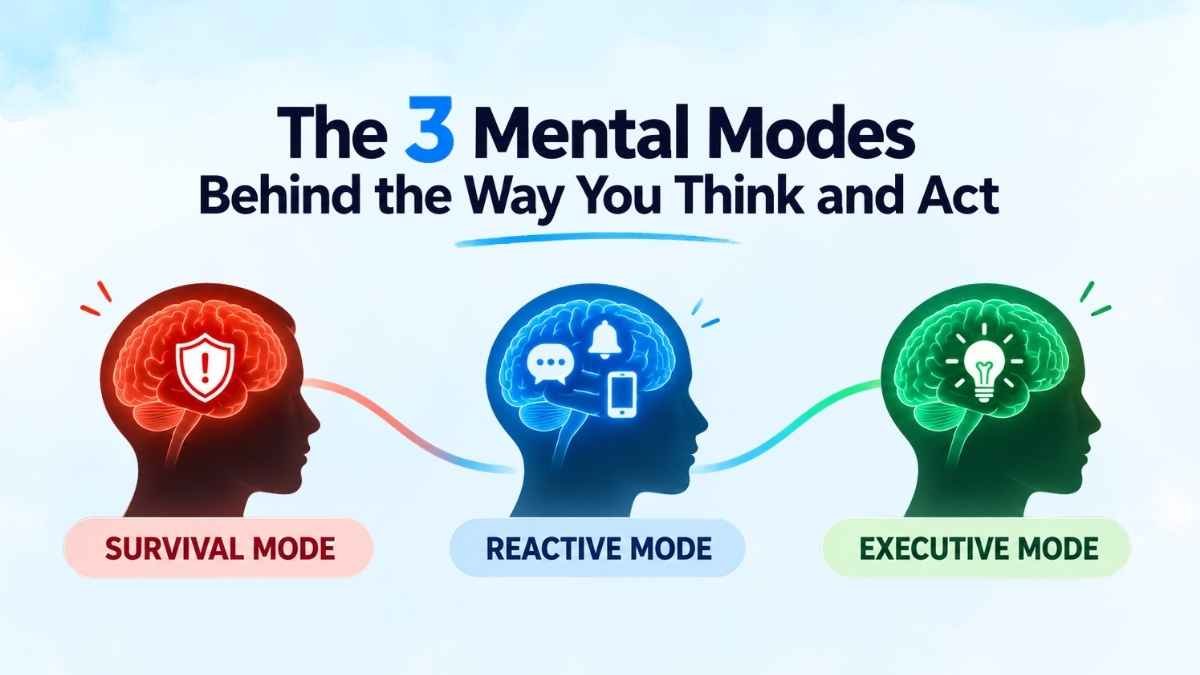

Quick answer: Your brain shifts between three everyday mental states — survival mode (reacting to stress or threat), reactive mode (following distractions and impulses), and executive mode (calm, deliberate thinking). Understanding which mode you're in helps explain sudden mood swings, procrastination, and why you make better decisions at some times of day than others.
Psychologists and behavioral researchers describe human attention and decision-making as shifting between three recognizable patterns throughout the day. These aren't separate personalities or clinical diagnoses — they're everyday mental "settings" your brain switches between based on stress, environment, and energy levels.
            Mode
            Trigger
            Main Focus
            Common Behavior


            Survival Mode
            Stress, pressure, perceived threat
            Immediate safety and relief
            Irritability, avoidance, snap decisions


            Reactive Mode
            Notifications, boredom, impulse
            Whatever grabs attention next
            Distraction, procrastination, task-switching


            Executive Mode
            Calm, low-pressure environment
            Planning and long-term consequences
            Clear thinking, prioritizing, patience
Survival mode is your brain's response to stress, urgency, or perceived threat. It narrows your attention to the immediate problem and increases irritability, impatience, and avoidance of anything unfamiliar.
This mode evolved to help you react quickly to real danger. The problem is that modern stressors — a tense email, a tight deadline, an unexpected bill — can trigger the same response, even though there's no actual danger.
Signs you're in survival mode:
To break the cycle: Pause and ask, "Out of everything on my plate, what genuinely can't wait past the next ten minutes?" Nine times out of ten, it's a single item — the rest just felt urgent because your stress made it feel that way.
Reactive mode is when your attention follows whatever captures it next — a notification, a passing thought, or a small impulse — instead of the task you originally intended to do.
This happens because quick rewards (a video, a message, a scroll) deliver satisfaction faster than effortful tasks like deep work or reading. Your brain naturally leans toward the easier, faster reward.
Signs you're in reactive mode:
How to shift out of it: Make distraction slightly less convenient — phone in another room, fewer open tabs, a timer set before you start, not after you've already lost the hour.
Executive mode is deliberate, higher-level thinking — planning, prioritizing, weighing consequences, and managing impulses. It typically shows up when stress has settled and demands have quieted, often in the evening.
Signs you're in executive mode:
How to access it more often: Build in a pause before big decisions — financial, relational, or career-related — rather than deciding mid-stress. Even a short delay (an hour, a night's sleep) shifts you from reactive to executive thinking.
All three. These modes aren't fixed personality traits — they're responses that shift based on sleep, stress, environment, and habits. You can move through all three in a single day, and sometimes even within the same hour.
The goal isn't to stay in executive mode permanently. It's to recognize which mode you're in and ask whether it actually fits what the moment needs.
Your brain adjusts its focus based on stress levels, energy, and environment. Morning stress often triggers survival mode, midday boredom triggers reactive mode, and calmer evenings allow executive, deliberate thinking to take over.
Not exactly. Survival mode is a short-term stress response to a specific trigger, while anxiety can be a more persistent, ongoing state. Frequent survival-mode reactions can contribute to anxiety over time, but they aren't the same thing.
Reduce easy access to distractions (phone in another room, fewer tabs open), and address the underlying discomfort — boredom, stress, or worry — that's driving the distraction, not just the device itself.
Yes. Building in small pauses before reacting, getting enough sleep, and reducing constant interruptions all make it easier for your brain to shift into calm, deliberate thinking more consistently.
It's best understood as a practical framework for recognizing everyday patterns in attention and stress response, rather than a formal clinical model. It draws on general concepts from stress and attention research but is not a diagnostic tool.
You are not a completely different person every time your mood, energy, or surroundings change. What changes is often the mental mode you're operating in.
Stress can push you toward quick reactions. Distractions can pull your attention from one thing to another. And when you finally have some quiet, your thinking can become more deliberate and future-focused.
The goal isn't to stay in executive mode all day. It's to recognize when you're reacting automatically and create enough space to choose what happens next.
Sometimes, a short pause, a calmer environment, or simply putting your phone away can make a bigger difference than trying to force yourself to "be more productive."
The next time you catch yourself thinking, "Why am I acting like this?" pause for a moment and ask: Which mode am I in right now?
That small question can be the first step toward responding with more intention instead of simply reacting to whatever happens next.
Explore Real News is a New Delhi-based digital media platform bringing readers informative and engaging content across lifestyle, business, technology, education, travel, entertainment, and other areas of everyday interest. The platform focuses on making useful information easy to understand while covering topics that connect with the experiences, interests, and changing needs of modern readers.
Through original articles and reader-focused storytelling, Explore Real News aims to inform, engage, and help readers explore ideas that matter in everyday life.